What Is Domain Authority?
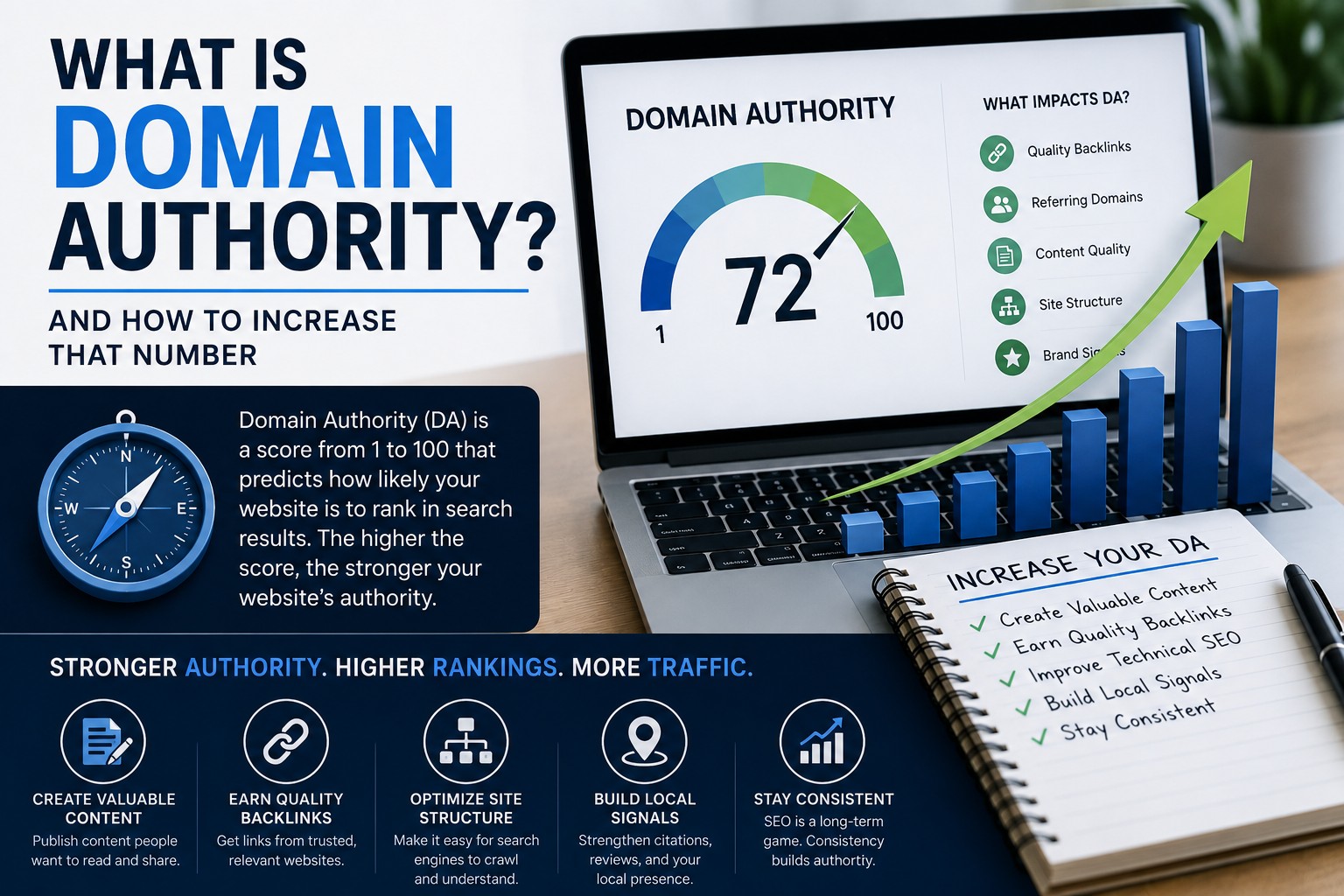
Domain Authority is a score created by Moz that estimates how likely a website is to rank in search results compared with other websites. The score runs from 1 to 100. Higher usually means the site has a stronger backlink profile and more ranking potential, but it is not a Google score.
That last part matters. Google does not open up Moz, Ahrefs, Semrush, or any other SEO tool and use that number to rank your website. Domain Authority is a measurement tool. A useful one, but still a tool.
Think of it as a quick way to judge the strength of a website’s reputation online. If your site has strong pages, solid links, useful content, local trust signals, and years of clean history, your authority score will usually be stronger than a brand-new site with five pages and no links.
At Personal SEO, we look at Domain Authority, but we do not treat it like the final answer. Rankings, traffic, leads, content quality, backlinks, technical SEO, and local visibility matter more than chasing one number.
Domain Authority Is Not the Same as Rankings
A higher Domain Authority can help explain why a competitor outranks you, but it does not guarantee rankings. A site with a lower score can still beat a stronger domain if the page is better, the search intent is clearer, the content is more useful, or the local relevance is stronger.
This is where people get it wrong. They see a competitor with a higher score and assume the whole game is backlinks. Sometimes, yes, links are part of the problem. Other times, the competitor simply has better content, stronger internal linking, cleaner site structure, or a page that answers the query more directly.
For example, a local real estate website like Bellingham Listings can build authority by publishing strong community content, linking related neighborhood pages, and earning mentions from local sources. A luxury real estate website like Luxury Homes SoFlo may need a different authority plan because the competition, price points, and search behavior are different.
Same metric. Different strategy.
Why Domain Authority Matters
Domain Authority gives you a rough read on how much trust and link equity your website has built over time. It is especially useful when comparing your site against direct competitors.
If your website has a Domain Authority of 12 and the sites ranking above you are in the 40s and 50s, that tells you something. You may still rank for easier long-tail searches, but highly competitive keywords will be harder. Not impossible. Harder.
Authority also affects how quickly new content can gain traction. A trusted site can often publish a new page and get movement faster because search engines already crawl it often, understand its topic areas, and see stronger external signals pointing to the domain.
That does not mean smaller sites are stuck. It means they need to be smarter. Better local pages. More specific content. Cleaner internal links. Real backlinks from relevant websites. Less generic blogging just to say something was published.
What Usually Affects Domain Authority?
Domain Authority is heavily influenced by links, but links are not the whole story from a practical SEO standpoint. A website with a messy technical foundation, thin pages, and no content strategy can still underperform even if it has a few decent backlinks.
The pieces usually worth reviewing include:
- Backlink quality: Links from trusted, relevant websites carry more value than random directory links.
- Referring domains: A site with links from many real websites usually has more authority than a site with links from only one or two sources.
- Content depth: Strong pages give other sites a reason to link, reference, and share your website.
- Internal linking: Good internal links move authority through the site and help search engines understand priority pages.
- Technical SEO: Crawl issues, broken pages, duplicate content, and poor structure can weaken how efficiently the site performs.
- Brand signals: Mentions, reviews, citations, profiles, and local references can support the broader trust picture.
A site like The Gelderman Group can build stronger authority by connecting market content, service pages, community pages, and useful buyer or seller resources. A site like Tampa Team TLC may benefit from a mix of local content, Tampa-area community pages, Google Business Profile strength, and backlinks from regional sources.
The work is not glamorous. It is usually steady, careful, and a little repetitive. That is why it works.
How to Increase Domain Authority
You increase Domain Authority by earning stronger trust signals over time. Not by installing a plugin. Not by changing one title tag. Not by buying 500 cheap backlinks from a spreadsheet.
Start with the foundation.
Build Content People Would Actually Reference
Most websites want backlinks, but they do not publish anything worth linking to. That is the first problem.
Strong authority content usually answers questions better than the pages already ranking. It can be a neighborhood guide, a market explanation, a buyer resource, a local comparison, a checklist, a data-backed article, or a page that explains a confusing decision in plain English.
For real estate websites, this might mean detailed community pages, relocation guides, waterfront buying advice, condo explainers, seller preparation content, or local market pages that go beyond basic MLS filler.
Personal SEO can help build this kind of content through SEO strategy, content planning, and site optimization. The goal is not just more pages. The goal is more pages that deserve to exist.
Earn Better Backlinks
Backlinks still matter because they act like references from other websites. The best links usually come from relevant sources, not random sites with no connection to your industry or market.
Good backlink opportunities can come from local organizations, sponsorships, guest contributions, business partners, chambers of commerce, local news, vendor relationships, podcasts, community resources, and useful content that other sites naturally want to cite.
Bad links are easier to get. That should tell you something.
Cheap link packages often create more risk than value. They can inflate numbers for a while, but they rarely build the kind of authority that supports long-term SEO. A smaller number of relevant links is usually better than a pile of junk.
Strengthen Internal Links
Internal links are underrated. They help visitors move through the site, but they also help search engines understand which pages matter.
A strong internal linking structure connects related pages naturally. A blog post about buying in a certain city should link to that city’s homes for sale page. A seller guide should link to a home valuation page. A neighborhood page should link to nearby communities, buyer resources, and relevant market content.
This is especially important for real estate websites because many IDX pages can feel disconnected from the rest of the site. Better internal links can help Google find and understand important pages instead of leaving them buried.
Fix Technical SEO Problems
Authority can leak through bad structure. Broken links, redirect chains, duplicate pages, noindex mistakes, missing canonical tags, slow pages, and crawl traps can all make the site harder to trust and harder to rank.
Google’s SEO guidance focuses on helping search engines crawl, index, and understand your content. That is the baseline. If Google cannot properly access your pages, the authority conversation is already off track.
A technical audit should review crawlability, page speed, indexation, sitemap quality, mobile rendering, schema, internal links, duplicate content, and page-level issues. For some sites, fixing these problems creates movement before any major link building begins.
Improve Local Trust Signals
Local businesses need more than links from traditional websites. They also need consistent business information, strong reviews, a complete Google Business Profile, local citations, and mentions from relevant regional sources.
Google says local results are influenced by relevance, distance, and prominence. Prominence includes signals like links, articles, directories, reviews, and overall web presence.
That means a local authority plan should include citation cleanup, review strategy, Google Business Profile updates, local content, and links from real local sources. Not just blog posts. Not just backlinks. The whole footprint.
Do Not Chase the Number Blindly
Domain Authority can become a distraction if you stare at it too long.
A higher score is nice, but the better questions are sharper:
- Are rankings improving for the keywords that matter?
- Is organic traffic growing from relevant searches?
- Are leads increasing?
- Are important pages getting indexed and crawled?
- Are competitors earning links or publishing content you are missing?
- Does the site have enough authority to compete in its actual market?
A Domain Authority increase that brings no rankings, no traffic, and no leads is not much of a win. It may look nice in a report. That is about it.
The better goal is stronger search visibility. Domain Authority is one signal that helps measure progress, but it should sit beside keyword rankings, organic traffic, conversions, backlink quality, content performance, and local search visibility.
How Personal SEO Looks at Authority
Personal SEO reviews Domain Authority as part of a bigger SEO picture. We look at what your site has, what competitors have, and what it would realistically take to close the gap.
That review may include backlink analysis, content quality, technical SEO, internal linking, local citations, Google Business Profile strength, page structure, and competitor authority. The work changes by website. A local service business does not need the same authority plan as a luxury real estate brand. A small town real estate site does not need the same link profile as a competitive metro market.
For some websites, the first move is content. For others, it is technical cleanup. Some need citations and local links. Others need a more serious authority-building campaign because the search results are stacked with stronger domains.
Guessing costs money. An audit is cleaner.
FAQ About Domain Authority
Is Domain Authority a Google ranking factor?
No. Domain Authority is a third-party metric from Moz. Google does not use that exact score to rank websites. The signals behind a stronger score, especially quality backlinks and trust, can still matter for SEO.
What is a good Domain Authority score?
A good score depends on the competition. A DA 25 site may do well in a smaller local market, while a DA 25 site in a major luxury real estate market may struggle against stronger domains.
How long does it take to increase Domain Authority?
Usually months, not days. Authority grows through better links, stronger content, improved technical SEO, local trust signals, and consistent publishing. Quick jumps are often temporary or tied to questionable links.
Can content increase Domain Authority?
Content helps when it earns links, supports internal linking, improves topical depth, and gives search engines more useful pages to understand. Content alone may not raise the score quickly, but weak content makes authority harder to build.
Are backlinks the fastest way to improve Domain Authority?
Quality backlinks can move the number, but bad backlinks can create risk and waste money. Relevant links from real websites are worth more than cheap bulk links.
Should I focus on Domain Authority or traffic?
Traffic, rankings, and leads matter more. Domain Authority is useful for comparison and progress tracking, but it should not become the main goal by itself.
How can Personal SEO help improve authority?
Personal SEO can review your backlink profile, content gaps, technical SEO, internal linking, local citations, and competitor authority. From there, we can build a practical plan to improve search visibility and authority over time.