
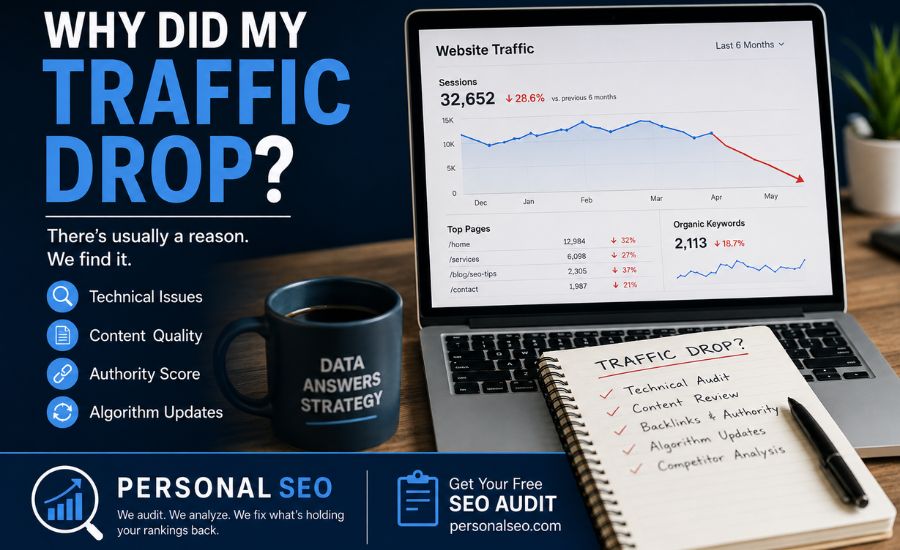
Why Did My Website Traffic Drop?
A traffic drop usually has a reason, but the answer is rarely obvious from one graph. A page can lose rankings because of a technical issue, weaker content, stronger competitors, Google changes, tracking problems, lost backlinks, or a mix of several things happening at once.
That is why guessing is a bad move. You do not want to rewrite a whole website if the real issue is indexing. You do not want to blame an algorithm update if Google Analytics was changed last month. And you definitely do not want to keep publishing content if the site has a crawl problem blocking search engines from seeing it properly.
At Personal SEO, the first step is usually a free audit. Not a scare report. A real look at what changed, where traffic dropped, and what needs attention first.
Traffic Drops Need Research, Not Panic
Most website owners notice the same thing first: leads slow down, calls get quieter, or Google Analytics shows fewer visitors than usual. That part is easy to see. The harder part is figuring out why it happened.
A traffic drop can come from several places:
- Technical SEO issues that stop pages from being crawled or indexed
- Content that no longer satisfies the search intent
- Competitors publishing stronger or more complete pages
- Lost backlinks or weaker authority signals
- Google core updates or ranking system changes
- Changes to tracking, analytics, redirects, or URL structure
- Seasonal demand shifts that look worse than they really are
Google has its own guide for debugging drops in Google Search traffic, and it makes the same point in a more technical way: a drop can come from different causes, so the first job is diagnosis.
That sounds simple. It is not always simple in practice.
Start With the Date the Drop Happened
The date matters. A sudden drop on one day points to a different problem than a slow decline over six months.
A sharp drop may suggest a technical issue, a noindex mistake, a migration problem, a robots.txt change, a redirect issue, or a tracking problem. A gradual slide usually points more toward content quality, authority, stale pages, competitor gains, or search behavior changing over time.
This is where tools like Google Search Console, Google Analytics, SEMrush, and crawl software help. You are looking for patterns. Did impressions fall? Did rankings fall? Did clicks fall even though impressions stayed steady? Did only one page drop, or did the whole site take a hit?
Those are different problems. Treating them the same wastes time.
Technical SEO Can Quietly Crush Traffic
Some traffic drops have nothing to do with the quality of the business or the usefulness of the content. The site may simply be harder for Google to crawl, render, or understand.
Technical problems can include broken redirects, duplicate pages, thin indexable pages, missing canonical tags, slow templates, JavaScript rendering problems, sitemap issues, internal links that disappear, or important pages being accidentally set to noindex.
Real estate websites can be especially messy here because IDX pages, listing pages, community pages, and search result pages often behave differently than normal WordPress pages. A site like Kime Realty, Marley Presswood Real Estate, or Rinaldi Real Estate may have valuable local search opportunities, but the platform structure still needs to give Google clean signals.
That is a big part of why Personal SEO works heavily with Sierra Interactive SEO. IDX-heavy websites need more than generic SEO advice. They need someone who understands how the pages are built, what Google can see, and where the template may be holding the site back.
Content Quality May Be the Real Problem
A website can rank for years and then slowly lose ground because the content no longer deserves the position it once had. That is blunt, but it happens all the time.
The page might be too thin. The local information may be stale. The article may answer the topic in a generic way while competitors are publishing better neighborhood guides, stronger service pages, clearer FAQs, and more useful internal links.
Google’s documentation on core updates focuses heavily on assessing and improving content. That does not mean every traffic drop is a content problem. It means content needs to be reviewed honestly when rankings fall.
For Personal SEO, that review usually includes questions like:
- Does the page answer the searcher’s actual question?
- Is the content specific to the service, market, or customer need?
- Are important pages internally linked from related pages?
- Does the site show experience and expertise, or just keyword coverage?
- Are there stronger pages on competitor sites that deserve to outrank it?
Most weak content does not look terrible at first glance. That is the trap. It looks fine. Fine does not win much anymore.
Authority Score and Backlinks Still Matter
Content can be strong and still struggle if the site has weak authority. Backlinks, brand mentions, citations, local profiles, and trusted references all help search engines understand whether a site has weight behind it.
A drop in traffic can happen when important backlinks are lost, competitors earn stronger links, or the website’s authority does not keep pace with the market. This is common in competitive real estate, home services, legal, medical, and local business spaces.
Personal SEO looks at authority score, backlink quality, toxic patterns, citation consistency, and local trust signals. Not every site needs a huge link campaign. Some need cleanup. Some need local citations. Some need better content worth linking to. Some need all of it, but in the right order.
Throwing links at a broken site is not strategy. It is noise with a bill attached.
Algorithm Updates Can Change the Landscape
Google updates its ranking systems regularly. Sometimes a site drops because Google has reassessed what deserves to rank for a query. That can feel unfair, especially when nothing obvious changed on the website.
But something did change. The search results changed. Competitors may have been rewarded. Some types of pages may have lost visibility. Google may be interpreting intent differently. AI-generated summaries, local packs, map results, forums, videos, and large publishers can also shift how much organic traffic is available.
This is why Personal SEO does not look only at the website. We look at the search results themselves. Who moved up? Who disappeared? Did Google start showing different page types? Did the query become more local, more informational, or more brand-heavy?
A recovery plan should fit the actual search result, not the version of Google that existed two years ago.
What Personal SEO Checks in a Free Audit
A good audit should tell you what is most likely hurting traffic and what should be fixed first. It should not bury you in fifty pages of jargon.
Our free SEO audit may review:
- Google Search Console performance trends
- Ranking drops by page and keyword group
- Indexing and crawl issues
- Technical SEO problems
- Content quality and search intent gaps
- Internal linking problems
- Authority score and backlink profile
- Local SEO signals and citation consistency
- Competitor movement in the search results
- Possible algorithm update timing
From there, the plan becomes clearer. Some sites need technical cleanup first. Others need better content. Some need stronger authority. A few need tracking fixed before any real SEO call can be made.
Do Not Fix Everything at Once
This is where a lot of businesses burn money. They see traffic drop and immediately order blogs, redesign pages, change titles, buy links, install plugins, and rewrite service pages all in the same month.
Now nobody knows what helped or hurt.
The better path is to isolate the likely causes, fix the highest-impact problems first, and measure what changes. SEO recovery is not always instant, but it should be organized. Random activity makes reporting messy and decisions harder.
Personal SEO focuses on practical next steps. If the site needs technical repair, we start there. If the content is thin, we build stronger pages. If authority is lagging, we create a link and citation plan. If the website is on a platform with known SEO limitations, we work around those limitations instead of pretending they do not exist.
FAQ: Why Did My Website Traffic Drop?
Can you tell why my traffic dropped without looking at my site?
No. A real diagnosis needs research. Traffic can drop because of technical issues, content weakness, authority loss, tracking changes, competitor gains, or Google updates.
What should I check first after a traffic drop?
Start with Google Search Console. Look at the date of the drop, affected pages, lost queries, impressions, clicks, and average position. That usually gives the first useful clue.
Could a Google update be the reason my traffic dropped?
Yes, but do not assume that first. The drop should be compared against known update timing, competitor movement, and site-level changes before blaming the algorithm.
Can bad content cause a traffic decline?
Yes. Content that is thin, outdated, generic, or poorly matched to search intent can lose rankings as competitors improve their pages.
Can Personal SEO help recover lost traffic?
Yes. Personal SEO reviews technical SEO, content, authority, search intent, and ranking changes to find the likely cause and build a practical recovery plan.
How do I get started?
Request a free SEO audit. We will review the site, look for the likely cause of the drop, and explain the next steps without turning it into a guessing game.